The first step is to penetrate the clouds of deceit and distortion and learn the truth about the world,
then to organize and act to change it. That's never been impossible and never been easy. ~Noam Chomsky

Showing posts with label ethics in adoption. Show all posts

Thursday, May 9, 2013

Adoption Truth Part IV: Pressed on every side


we were pressed on every side
full of fear and troubled thoughts
for good reason we carried heavy hearts... (Sara Groves)


For good reason we carried heavy hearts.
That is how I feel. Heavy.
But also free.
The juxtaposition of heavy and free don't sit well with me.
Shouldn't free feel light?

This post is my attempt to shed some of the weight.

...........

Adoption Truths Part IV: Pressed on every side

We are in a situation where it is impossible to please everyone.
I love to make people happy and to please others. But the older I get the more I have come to realize that being a people pleaser is at unfortunate odds with being a truth-teller.

Watershed moment... I can only tell our truth with as much wisdom and sincerity as possible. But I cannot be responsible for how it lands in other people's hearts and whether or not it is "pleasing."

This post is my attempt to put to words the ways I feel pressed, pressed to please. Hoping to find personal freedom from this pressure simply by recognizing it. "Hello pressure, I see you. And now I write this to release you."

When an adoptive parent finds herself telling hard truths about her adoption several things seem to happen. (Generalizing here from a very unscientific observation of the adoption blogging community over the last 4 years.)

1. Close friends and family rally. They pray and cheer and hold you close. But you worry about their longevity. They see you changing. They may suggest that you are putting yourself in danger for a "cause." Can they hold on and stick with you long term? Nobody really wants to be left hanging without resolution forever. Family and friends don't really know what to do or say. You find yourself tucking in, hiding out. Because it is hard. You are not fun. Truth telling sucks a lot of the fun and life out of you.

2. Adoptive families who have been through hard times and lived their own hard stories quietly (and sometimes not so quietly) share your blog, press like, and leave long comments sharing their pain, frustration, and fear. They want you to to press forward. Say it all. Call people out. They hope to God that you can accomplish something that they couldn't. Maybe you will finally be the family that doesn't sign the gag order offered by the agency. You feel responsible as this group's newest vocal representative.

3. Families in process or families who have not experienced difficult stories feel awkward. Sometimes they feel attacked. Sometimes they feel like you are saying they should not have adopted or should not be adopting. Sometimes they extrapolate that your warnings and concerns are actually sweeping anti-adoption statements. Not all, but some, pull away. Some scramble to reduce your credibility. (In our case we've had people say that we are "not real Christians", "frauds", and that we are "crazy.")

"Families that speak out against agencies and tell stories of fraud in their processes and want to warn other families looking to adopt or who are in process are consistently shut down. They are shunned. They are told they are mood killers. They lose real life friends and Facebook friends. They are kicked off of support groups. They are asked to stop talking because they could ruin adoption for everyone else.
But I want it to be clear: families who beg for someone, anyone to listen to their story are not ruining anyone's adoption. It may feel like they are threatening something dear to the heart. Something prayed about, stressed about and let's not talk about the savings and check writing. But really, they are not threatening adoption. The agencies they are trying to chuck a stone at, like David against Goliath, who participate in child trafficking, or forge documents, or don't investigate "abandoned" children's history, or turn a blind eye to poor practices, they are the ones that are ruining adoption." (Staci from Scooping it Up)

4. Adult adoptees. Some, not all, begin to read your blog. Maybe they have read along from the beginning but many are new to you. They are reading because a post went viral. They cheer that someone is standing in their camp. That an adoptive family is advocating for truth, reform, first families and giving voice to adopted children who will grow into adults.

You begin to feel that you owe it to them, almost as projections of your current children's future adult selves, to stay the course. You don't want to let them down. You become scared that they will be disappointed in you. You wonder if they will still be cheering if you end up completing your adoption.

5. The folks who just think adoption is a load of crap. They are out there and they have some valid reasons. They often also have extremely hard stories. They may love one post of yours but hate another. They are often anonymous and while their comments have truths they bite so hard that you have no idea how to engage with them.

6. The faith community. I am part of this community and maybe you are as well. Many in this community do not like public strife and do not want to see anyone question a Christian adoption agency. Some feel that any problems between professed "Christians" should be worked out behind closed doors. Some do not want to recognize that there are people who masquerade under religious "Christian" language but have bad intentions and/or poor practices. You need this community more than ever but it no longer feels safe.

Recently on a Haitian adoption forum filled with Christian adoptive parents someone demanded that I provide "proof/evidence" of my concerns. And then I was kicked off.


"Here is the biggest problem with proof and details: adoption lies and fraud and corruption don't just involve adoptive parents. At the heart is a child or children. And having major or heck, even minor ethical issues in an adoption story is a little like having your child be abused. If you come out against the perpetrator (who may be popular, powerful and big or even really nice) your child's story, the details of their pain is now fodder for the Internets to criticize, dismiss. To seek justice, to warn others, to appease people and convince them "it's true" you essentially must throw your family under the bus and expose yourself and your child to ugliness.

That is the reason most families stay silent. That is the reason many people don't report abuse: it is hard to prove, it can feel like shame, it can harm our kids more than they've already been harmed.... How do you prove to people that fraud happens and that agencies are either complicit or know about it/suspect it but have personal philosophies that justify the fraud? How do you convince people without specifics that throw a kid's privacy in the garbage?" (Staci from Scooping it up) 


What to do? Pressed on every side. There is no way to win and absolutely no way to please everyone.

"There's redemption in confession and there's freedom in the light. I'm not afraid, I'm not afraid...."

I'm going to keep saying that until I feel it. And I am going to keep writing until there is nothing left to hide. I am going to do my best. Thank you to those who choose to stay with me in this Adoption Truths series. I know it isn't light reading. But thank you.


go on and ask me anything
what do you need to know
I'm not holding on to anything
I'm not willing to let go of
to be free, to be free

it's a sweet, sweet thing
standing here with you and nothing to hide
light shining down to our very insides
sharing our secrets, bearing our souls,
helping each other come clean
secrets and cyphers
there's no good way to hide
there's redemption in confession
and freedom in the light
I'm not afraid, I'm not afraid
(Sara Groves)


~A


Sunday, May 5, 2013

Adoption Truth Part III: Adopting Again

Let's get this show on the road, yes?
I'm sorry for the long delay in posting. I was in Haiti. Again.

Thank you for reading, commenting and reposting parts I and II. Your comments, even when questioning, were so full of grace. I try to remember to give more grace when I am the recipient of so much.

Thank you for recognizing that the stories I'm telling here are glimpses. Snapshots. Thoughts in time. They can never be our full story and will never reveal more about our daughter or son than we think is acceptable to share publicly (which we recognize is walking a very fine line.) It is a thin line that I'm walking only because I believe with my whole heart that truth and light can dispel darkness and create change.

......

Adoption Truths Part III: Adopting Again

If we were so concerned with Ariam's mother's story, why on earth did we start a second adoption?

In fall of 2011, while we were still putting together puzzle pieces of Ariam's story and wondering if this story was an anomaly, we began to discuss a second adoption. We sorted through our desires, a potential second child's needs, Ariam's needs, and all of the options for expanding our family.

I think that whether you have adopted or not you will probably resonate with our reasons for adding a second child to our family.

Reason 1 - we wanted children, plural. We wanted to be a family and we wanted Ariam to have a brother or sister. We did not want to rescue a child, be "saviors" in the eyes of our community, or do some act of charity. It is a selfish reason to adopt - wanting a child. But if done right, there is actually no better reason, in my opinion, to adopt than *wanting* a child. Wanting to be family for and with a child.

Reason 2 - We didn't want Ariam to be the only person of color in our entire family. We were reading more writings from teen and adult adoptees and unanimously they felt that being the "only one" (adopted, with special needs, different ethnicity, whatever the case) was hard. Uncomfortable. An extra burden.

I won't forget the day we were with our extended family in a restaurant, all of us white as white can be, and I realized that all eyes in the restaurant were on Ariam. Talking, laughing, animated. She didn't seem to notice. But I did. And I don't want that for her. I want her to have siblings with whom she can share this unique experience of being adopted in a transracial family.

The day we told Ariam that she would be a big sister to a little boy she asked "will he be chocolate like me?" (She was 2.5 and still thinking of skin as a color not a race or ethnicity yet.) I know her well enough to know that she would love any baby. But her reaction to the knowledge that yes, her brother would look like her, was confirmation to me that we had made the right decision for our family. And for our children.

Throughout the year she has checked in on this with us. "Will he be brown like me mom?" "Is he definitely going to have black hair like me?" "He and I will be the same just like Mia and her sister are the same and like Roan and her brother are the same!"

She has never wavered in her love for this little brother. Across time and space, across more than a year of her young life, through confusion and delays and questions he has been the dream she holds most dearly.

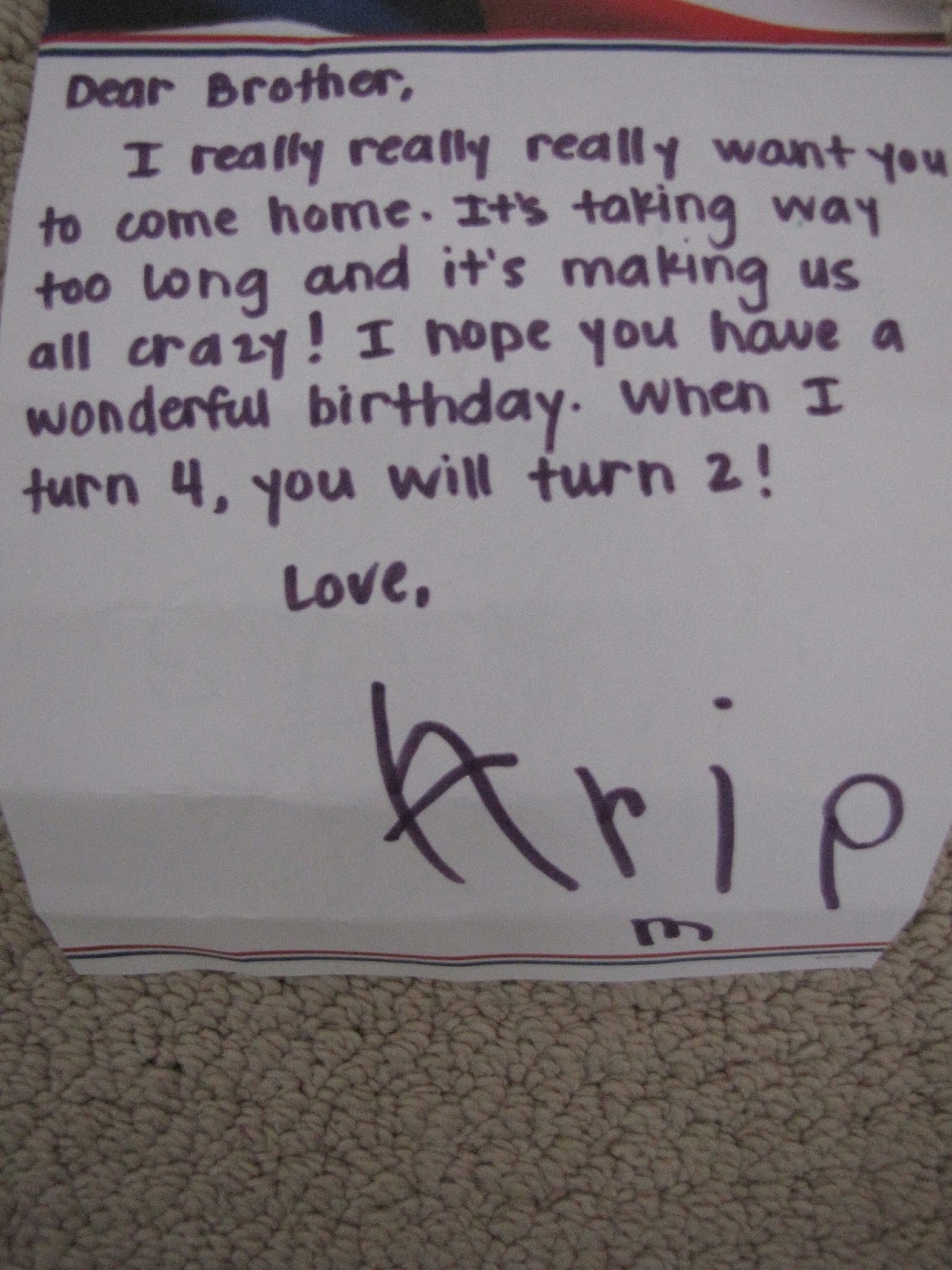
(Transcribed by her preschool teacher. We have dozens of these type of letters.)


There have been moments in recent months when we have thought we would need to break it to Ariam that this little brother of hers, held so close to her heart, would not be coming to live with us.

We made the hardest decision I think any adoptive parent has to make (and yet at the same time this seems like something so very basic and obvious to anyone who is not adopting!) We needed to find out if this little boy's living birth parent had been coerced to relinquish him for adoption.

We are waiting for the end of this story. It is not quite finished yet. (Sometimes truth, when dealing with cross cultural communication, requires the allowance of time and patience.)

I hope to share more of this journey with you at some point in the near future. Not because I have any interest in exposing our most personal fears, stories, or our child's life details with the internet community at large. But because this entire story sheds light on aspects of adoption, agencies that masquerade as "Christian" and the dangers of group think that we all need to be more diligent in discussing and working to change.

And because we have come to this exhausting but liberating realization..
until we can lay down our hopes, dreams, desires, image of our family, and even the child we hope will be ours on the alter of truth, we will never actually be capable of fully seeing truth or acting on it. (This is the hardest realization I have ever come to. Ever. It should be so simple, but it is not.)

~A

“Silence in the face of evil is itself evil: God will not hold us guiltless. Not to speak is to speak. Not to act is to act.” -- Bonhoeffer

We intend what is right, but we avoid the life that would make it reality. -Dallas Willard

For what you see and hear depends a good deal on where you are standing: it also depends on what sort of person you are. ~C.S. Lewis, The Magician's Nephew


Thursday, April 11, 2013

Adoption Truth Part I: I have changed

Thanks for joining my recap of 2012. It was necessary for me to post. A reminder that in the dark and hard places of our life there is also light and beauty and so much love.

And now, to start the story. I need to ask for your grace. This blog is about to get a lot less rainbows and unicorns and pretty photos. I am not perfect and certainly don't have all the answers. What I have to share is deeply personal and it scares me to put it all out here in this way. Please be gentle with me. And with yourself. More than anything I am aware that adoptive parents read this blog and that words have a powerful way of touching places in our lives that we didn't want to disturb or consider too closely.

Thank you for coming back after I've been gone so long. Thank you for caring.

........................
Part I


I am not the same woman I was when this blog was born. Our adoption of Ariam has deeply impacted and forever changed the way I see the world. Reading my blog from inception to present, in preparation for reopening it, was so eye opening.

The most significant change I see is in my perception of the adoption triad (in our case, to keep it simple)– birthmother, adoptive mother, daughter. Daughter to two mothers. Mothers sharing daughter. Across time, space and beyond all comprehension, we are sharing.

We became parents to the most amazing, fantastic, joyful, loving, funny, animated little girl on planet earth in June of 2010.

And at least once each week I look at this little girl of mine and think about the girl who gave her life.

And Ariam asks about that girl-woman regularly. We talk about how we’ve heard that her nose was so similar to Ariam’s. How she also had light coffee colored skin. We talk about how sparkly her eyes must have been. I am deeply moved by this woman who connects us and I know that Ariam is as well.

We searched for her and that search turned upside down everything I thought previously about adoption. It is very clear to us that adoption was not Ariam’s birthmother’s plan. It has ended up as Ariam’s best second option. But it was not predestined, it was not “meant to be” and it most definitely damaged an inherent human right. The right her mother should have had to be involved in decision making about her daughter’s care. 

I am going to share something here that has forever damaged something in my soul and for which I hope Ariam forgives me someday for sharing. Because it will change you too. And you need to hear this before I can move on to part II of our story.

We learned that when Ariam’s girl-woman birthmother learned she was gone from the place she had entrusted her and gone from Ethiopia. She lay on the floor and cried. She cried for ‘days’.  

that is not ok. That image of her haunts me. It will not be ok with Ariam. It is not acceptable in our book and we don't think it is in God's plan for his creation. It was the consequence of a choice her birthmother made. But it was not the logical linear consequence. It was not a consequence that would have occurred if the local orphanage had taken the time to investigate. In the same situation, it was not a consequence I would have had to pay for a youthful mistake. And it was a harsh penalty a young woman paid for some poor decisions - made with very few alternative options.

I am changed. I am humbled. I am seared to the core. And I can never go back and be the same person I used to be. She can never be the same person she was growing to be.

As for Ariam. She doesn't know all of this story yet. So we won’t share more here. But she is a deeply thoughtful, caring, and empathetic little girl. She is the girl who rubs her friends’ backs at preschool when they are sad. She is the one who tells me she will hold her little brother to her heart when he is scared. She is the one full of love, hope and trust. She writes us love letters and brings them home from preschool daily.

Someday her heart will break when she learns her complete story. How could it not? 

This experience has shaped our family. It has shaped the way we view adoption. It has profoundly impacted our view of birth families and our appreciation for the difficult choices they make. And the ridiculously unfair and unjust "options" available (or forced) upon them.

We know, beyond a shadow of a doubt based on our experience, that orphanages can create “orphans” and that adoption can create orphanages. And if neither existed many children would remain in some form of family care either with their parents or extended family.

And yet we also know that, without adoption as an option on the spectrum of care, many children would grow up alone, in institutions, without a family.

HOW to reconcile these two?

We are complicit in this system. A system that provides families for some children who are very much in need and that creates “orphans” out of others who have living, caring, and with some support entirely capable birthparents.

We are complicit because we want to be a family. We want to be parents. We want to bring Ariam’s little brother home from Haiti. As adoptive parents, it is incredibly hard to overrule wants/emotions with sense, logic, justice, big picture thinking. I know it is excruciatingly hard because I live this.

Let’s start here. Let’s start this blog over with the premise that we have arrived at the awareness of this tangled complexity. And that we have come to some conclusions based on our ongoing experience with adoption. 

We as a family are awakened to the knowledge that we are complicit in a system that does not always serve those who most need it.
We have been complicit. But no more.  
Done with the group think.
Done with feeling emotionally held hostage.
Done thinking of our wants and needs and placing the highest priority on those.
Done turning a blind eye to red flags.
Done stepping on egg shells with agencies and their leadership.
Done worrying about the public opinion of other adoptive parents. 

We are in no way “anti-adoption” but we are fully awake to the fraud, injustice, and perpetuated cruelties of the “system.”

So.
On February 26, 2013, with final adoption decree in hand, we removed our son from the agency and orphanage that had been overseeing his care in Haiti. Putting our own adoption (our ability to get a US visa to bring him home) on the line and in jeopardy for the sake of the truth. 

I began this blog by wanting to add something to the story. When it seemed our adoption in Haiti could be on the line and we had to make some big choices, I was too scared to continue writing.

But no more.
For Ariam. For AJ.  I love you both. This work is my gift to you – your past present and future. This is our new beginning at the Watershed.

~A

Monday, July 11, 2011

The Birthmother: The thin line between relinquishment and abandonment

The story I'm about to tell is already 40 days old.
It took place during my search for Ariam's birthmother in a town about 40 minutes outside of Addis Ababa.
My van, filled with key players related to Ariam's story that I had gathered for the day, stopped at the small office of the local ministry of women's affairs. As things generally play out when I'm in Ethiopia (or anywhere in east Africa), I didn't have a clue what was going on.

Maybe I wish I had said no. Maybe I wish I had stayed in the van. But I don't have the option of going back and changing anything about that day.

...............................................................

I watched a mother try to relinquish her son today. I watched him reach up a small hand and hold it to the back of her neck. I watched her reach back reflexively to cover his little fingers, accustomed to their pattern of touch. She didn't realize that while her words said "I need to give him up" her actions said "but I love him, I do."

I watched a mother come to the end of her road, no longer able to walk the path of caring for a son with such obvious challenges ahead.

She stood outside the office door, summoned for her consultation. For an hour the women around her discussed, analyzed, negotiated. Sometimes they would close their circle of voices and leave her on the outside and other times the circle would open and she'd be called back in.


Would some money for medicine help? What about sponsorship? Could the orphanage director take him?

When the final pronouncement was made it was a no. Nobody would take the little boy with Down Syndrome because there would only be a life in an orphanage - no family would want to adopt him.


I watched a mother crack wide open. For just a minute the flood of fear burst through her composed exterior. She bent over double and I recognized that reflex our body does before it gets sick. Wracking sobs, the cries of a heartbroken widow, a scared and tired young mother who has carried her love on her back for two years but who can't walk a step further with him.

I wonder silently if she has seen other children adopted and has a daydream for Dani - that he will go to another country where she could imagine that he was living and thriving. Or if she has not thought about adoption at all and just needs to say a final goodbye, no matter what happens after.

She begs. I watch a mother beg. She's unwrapped him from her back and shifts him from arm to arm while she cries and alternates between holding him out and holding him close. After an hour of discussion, she stands straight, she closes her expression. She wraps him back onto her back and readies herself to leave.

It is clear to all from her words (they say she said "I just want to leave him here, go far far away and never look back") that he will be left. Maybe tonight, maybe a week, or maybe a year from now. But he will be left and he doesn't even know it. With innocence he has giggled through this soul altering crisis today. He doesn't know he will be left, but we do.

Pardon her expression - she was sniffing back tears. She wasn't trying to look so angry as far as I could tell.

...........................................................

This little boy's name is Dani (Daniel.) He was born with Down Syndrome to a mother who has a 6 year old daughter and who recently lost her husband. She is very obviously depressed. The ministry officials say she is "disturbed" but I think they mean depressed. Or maybe they do mean mentally disturbed. I think I would be if I were in her position.

Her husband died, she ran out of money and medicine and brought Dani to relinquish him. The orphanage director I was with was asked to bring her two social workers to the ministry's office to discuss the situation. Her pronouncement was that "there are no adoptive parents who would want this child." They are seeking a sponsor for the family. If you are reading this and feel so moved please leave me a comment. I think sponsorship is about $35/month. The orphanage director is funding the sponsorship for now but her funding is limited. Long term support will be needed if the mother does not abandon Dani.

I asked if sponsorship would make the difference between family preservation and abandonment in this case and they are unsure. Efforts will be made. But the consensus was that most likely the child will be left.

It is one of the biggest tragedies in international adoption - that the children who could most benefit from an adoptive family in a resource rich country like the U.S. will most likely not be the ones who get adopted. When I told the orphanage director that I thought some families in the U.S. might be interested in adopting a child with Down Syndrome she looked shocked and skeptical. That has not been her experience. Our daughter was the only child she's ever seen adopted after being diagnosed with a medical need. She could not take Dani and risk having to raise him in her orphanage for 18+ years.

So he will be left at the doors of the ministry most likely. Because apparently that is what happens in cases like this. And I have no idea what will happen to him then.  I assume he will disappear over time. Or he will remain with his birth mother and disappear over time unless she gets a lot more support to keep him and care for him.

I'm asked often how I feel about Ethiopian adoptions. I really have no answers, only complicated stories.
~A

*It was agreed by all that I would take photos and post them online. The photos above don't quite capture the situation but I could not bring myself to photograph some of the more intense moments.

Saturday, March 12, 2011

Take a deep breath and count to five...or twenty?

EDIT: I have found a blogger who is capable of writing the words I would write. Like we have have an internet mind meld. Makes my job easier because I can just link to her

My flu-addled brain wrote the words below but I think that anyone interested in the topic of the current state of Ethiopian adoption should skip over to Grace and then come back here - or reverse.

Now back to your originally scheduled programming:


I've had the flu all week but have still managed to catch many of the highlights surrounding MOWA's announcement to reduce the number of letters they write each day (approving each potential adoption) from 50 to 5.

Some dingbat at V.oice of A.merica kicked off the panic, I believe, with an inflammatory headline stating "Ethiopia to cut foreign adoptions by 90%." Yes, I guess the math is there but the heart of the story is missing.

What potential adoptive parent wouldn't feel that headline cut right through the heart? This time last year - I would have!

Adoptive parents don't just, swish!, sign on with an agency and receive their child. No, there is the paperwork, the waiting, the finances, the waiting some more, the receiving of a match, the photo you fall in love with, the waiting and agonizing. Have I mentioned the waiting? Whether adopting through a traditional infant program or adopting older kids or kids with special needs, we all wait and agonize.

One of the steps J and I struggled with in our wait was the wait for MOWA (Ministry of Women's Affairs - which is now MOWCYA I believe) to write our approval letter and send it to the court. We failed court three times because MOWA had not written the letter approving our match and confirming that Ariam was available for adoption. It was awful. And yes, when you are in the process and waiting for that letter you do go to a strange "why the hell can't somebody just whip up a form letter and sign the damn thing already??!!" type of place. Been there. Have much empathy for everyone going through it.

But back to the inflammatory VOA article.
I read it and I thought - huh. Well MOWA must be under additional stress and backlog. There have been new requirements set in place by both the ET government and US Embassy requiring additional documentation before a child can be adopted. It makes sense that MOWA, already unable to get letters out for every matched family/child in a manner we consider timely, already being inundated with stories of adoption fraud, would need to regroup a bit. (Big benefit of having Ariam home is that I'm able to think much more logically. I want to recognize here, formally, that this is something very very hard to do when you are anywhere in the process prior to bringing home the child you have waited for.)

So here's my thought: MOWA isn't a person - it is a ministry. A collective group of people about whom I know very little. But you have to consider that like any other office in the world, MOWA has staff turnover, MOWA has the need for trainings, MOWA had changes in leadership. MOWA oversees all of the issues related to women, children and youth in Ethiopia. Take that in for a second! Wow!

MOWA is not a ministry designed by the American people expressely set up to write letters for us.

There was a lot of frenzy online after the article came out. A lot of praying for Ethiopia. A lot of weeping and gnashing of teeth for children who may not be adopted because of this. More knee jerk reaction math was done and headings began to go the direction of "Ethiopian adoptions will now take 7 years on average."
A letter writing campaign was initiated asking adoptive parents to send in their happy stories and bright photos demonstrating successful adoption and a petition circulated.

Whew! I came up from my fever a few times to take a peek around the internet and quickly went back to bed.
Several friends have asked me what I think, given some of my professional connections in Ethiopia, and it's now or never for stating something. So take it or leave it, try not to take offense, here is what I think.

A. Children should not be raised in orphanages. I will always start with that. It's like a geometric theorem. One must always start with that.

BUT, given A....

B. International adoption is a tiny dent in what is actually a large scale child protection problem in Ethiopia. Whether we like it or not, nobody can argue that international adoption by itself is going to solve any kind of "orphan crisis." Studies are actually emerging indicating a distinct correlation between the increase in international adoption and the increase in the number of orphanages built in parts of Africa. Chew on that for a second....

C. MOWA wants to invest more time and resources into child protection and addressing the need for domestic solutions for children. They stated this very publically, to very little online applause from the adoption community.

I actually think this (not the reduction in letter writing - rather, the public committment to improvement) is the beginning of a huge step in the right direction for kids in Ethiopia.
If you take A, provide for B, and factor in C...maybe you actually come out with a solution that keeps more kids out of orphanages in the first place.

Ok, on to the rest of the list.

D. Ethiopia is not the United States of America. And Ethiopia does not have a responsibility to supply children to the world. I know, you are cringing and feeling defensive.

E. Let me ask provacative question - is the rush to petition a race and/or poverty issue? Honestly and truly? Maybe it is not for some and maybe for others it is. I don't know. The history of colonization is not a pretty one. History is littered with lighter skinned people taking control in countries they feel are "less civilized." Less able to manage themselves. Obviously not competent. While I am no fan of the Ethiopian government as a whole, I just cannot support this mass criticism and petitioning of a ministry that to all intents and purposes just announced that it is going to provide an increased focus on domestic solutions. We are all upset. We want to adopt our first Ethiopian child - or a sibling for our current Ethiopian child. We feel called. We feel righteous. We feel noble. We care. Whatever the reasoning (and I fall into ALL SORTS of those categories above) do we really have the right to impose our will?

F. I did not sign the petition or send in a flowery story with photos demonstrating the success of my adoption.

I think there is a VAST DIVIDE between our intentions, our actions, and the message received. If I can't control the message actually received then my intentions are irrelevant. The only thing I can control are my actions.


These are my thoughts.

As of this morning it appears that MOWA has decided to write 20 letters/day.
I don't believe this is an example of the collective bargaining power of the petition.
It's my understanding that this, and other improvements, to the "five letter situation" is a reflection of the good work of U.NICEF, the hard work of the embassy and the committment of a lot of child welfare professionals and others in Ethiopia. All who are concerned that children not fall through the cracks. I know that post-earthquake in Haiti, U.NICEF dug itself a bit of a grave with the adoption community. But let me assure you that in Ethiopia this is an office working incredibly hard to advocate for children to be out of orphanages and in families - whether those homes be in country (first choice) or overseas.

I think we'll see a stabilization in weeks to come. I've been too sick to try and collect all of the online links for you here but I do like The Wayfarer since it seems to always include both sides of every story and is fairly up to date with a list of who, what, when, and why. (Don't hold me to that - I've just skimmed the site today to make sure most of the news is posted.)

Now go ahead, shred me if you want to.
I didn't write any of this in anger or to divide the adoption community even further.
I just think that so often we (the collective we) in the U.S. forget that our reality and the reality on the ground, in the field, in the hard places is very different.

Collective deep breath in, collective deep breath out.

~A.